
Leaving Certificate Home Economics Social & Scientific
Number of classes per week: 5
Expected hours of homework/outside study per week: 2.5 hours (min)
Course Outline:
| Core Units
1. Food Studies 2. Resource Management and Consumer Studies 3. Social Studies |
Elective Units (Choose one)
1. Home Design and Management 2. Social Studies |
Assessment:
Food Studies Practical Coursework Journal: 20% of Final Grade.
Five assignments will be issued to the school at the beginning of Fifth Year. Students are required to complete four of the five assignments (these are common to Higher and Ordinary Level) The complete Food Studies Practical Coursework Journal must be submitted for examination in November of Sixth Year.
Areas of Practice:
- Application of Nutritional Principles
- Food Preparation and Cooking Processes
- Food Technology
- Properties of Food
- Comparative Analysis including Sensory Analysis
Exam Paper: 80% of Final Grade.
The exam is 2 hours 30 minutes in duration. Structure:
- Section A: 12 Short Questions – do 10 (6marks each)
- Section B: Compulsory question 1 (80 marks), 4 other long questions – do 2 (50 marks each)
- Section C: Elective (80 marks)
Skills Required:
Time management, organisation, discipline to work independently, problem solving, adaptability, analysis and application, investigation, and a strong work ethic.
Future Prospects:
The learning experiences in home economics develop flexibility and adaptability in students, prepare them for a consumer-oriented society and provide a learning foundation for a wide range of careers in food, textiles, science, design, social studies, education and tourism.
- Published in Subjects
Physics
Physics is the basic physical science. Physics is concerned not so much with ‘”what is so” but rather “why” it is so. It deals with topics such as forces, motion, energy, electricity and nuclear energy. It is a 2 year course with a maximum of 24 students per class. It is examined at two levels – ordinary and higher level. Topics at higher level get a greater depth of treatment, and students at higher level are expected to be proficient and comfortable with analysing and solving mathematical problems.
Course content:
Mechanics – force, energy, power, motion, gravity, density, pressure
Sound – waves, Doppler effect, notes, resonance, sound intensity.
Heat and Temperature – heat transfer, heat capacity, thermometers.
Light – mirrors, lenses, colours, electromagnetic spectrum
Electricity – static electricity, resistance, domestic circuits, semi-conductors, electromagnetism.
Modern physics – thermionic emission, photoelectric effect, x –rays, radioactivity, nuclear energy.
Students also study one of two options – either particle physics or applied electricity.
Assessment
The examination consists of a 3 hour written paper (worth 100%) and is divided into two sections.
- Section A (30%) questions students on 4 of the mandatory 26 experiments which students carry out over the course of the two year Leaving Certificate programme. Note: these experiments are to be written up by students in an experiment copy and available for inspection by the Department of Education and Skills.
- Section B (70%) questions students on concepts in physics and tests students’ ability to apply these concepts in solving mathematical related problems.
Requirements to study Physics at Leaving Certificate
- It is imperative that students have a genuine interest in and aptitude for science.
- It is preferable for students to have studied and passed science at higher level for their Junior Certificate.
- It is preferable for students to be competent and comfortable with mathematics.
- Students must have an inquisitive mind and a desire to know why things work as they do.
Career opportunities
- Astronomy
- Geophysics
- Radiography
- Electronics
- Biomedical engineering
- Mechanical engineering
- Civil engineering
- Computer engineering
- Military
- Second and third level education
- Radiation protection
- Environmental monitoring
- Telecommunications
- Graphics/Software design
- Programming
Is physics for you?
- If you want and enjoyable and rewarding career where you use your imagination, your practical ability and your creative flair, then physics could be for you.
- If you are studying higher level maths and/or applied maths, there will be some overlap with physics.
- If you are thinking about engineering, medicine, dentistry, electronics, astronomy or technology, then physics is for you. Physics can be required for some engineering courses and physics courses and is highly desirable for most science related and engineering courses.
- Physics rewards the capable, hard working exam candidates. At higher level each year, approximately 10-11% of candidates secure a H1, and 27-28% of candidates secure a H1 or a H2.
- With a physics qualification, you could choose to work in the open air, in a hospital, in a laboratory team, in engineering, in education or in many other environments.
- Published in Subjects
Senior Cycle Music
Leaving Cert Music consists of 4 parts. Each part is worth 25% of the exam. Total marks awarded for the exam is 400. The components of the exam are:
Listening Paper This consists of 6 questions – 4 set works, Irish Music and an unprepared Aural Skills question. Total – 100 marks.
Composition Paper This consists of 2 questions – a melody writing question and a harmony or backing chords question. Total – 100 marks.
Practical Each student must play or sing 4 songs/pieces, either as a solo or as part of a group. Total – 100 marks.
Higher Level Elective At higher level the student then chooses one of above areas in which to do extra work. Most students choose to do extra Practical work, which consist of a Computer Option, in De La Salle College we use a programme called Sibelius. This involves inputting one score of 4 parts onto computer using Sibelius. This is examined the same day as the Practical exam in March/April. Total – 100 marks.
Ordinary Level The ordinary level student does not need to do any extra work. Whichever of the first 3 components of Listening, Composing and Performing (or Sibelius) he scores highest on, that mark is doubled by the examiners.
Skills needed? An ability to read/write Music is desirable but can be taught in 5th Year. Ability to sing/play any instrument is also desirable.
- Published in Subjects
Leaving Certificate French
Introduction: The quantity of students taking L.C. French at Higher Level in DLS is way above the national average. As for the Junior Cert., it is a very accessible subject whose workload is not particularly heavy but from which very valuable points are earned. For those students wishing to have a foreign language solely as a third level entry requirement, French is very undemanding for the Ordinary level Leaving Cert. exam. Be conscious that student’s options can change dramatically and many find themselves, in 6th year, panicking because they suddenly find that a foreign language is required for their new choice.
Number of classes per week: 5
Course Outline: The syllabus aims to develop learners’ communicative skills in French, to develop their strategies for effective language learning and raise their awareness of cultural, social and political diversity.
Assessment: The syllabus aims to cater for a wide range of pupil ability. Assessment will be at Higher and Ordinary level.
Higher Level
Oral- 25%
(Topics for discussion include; myself, my family, my town, past times, what I did/will do on holidays, future career etc.)
Listening Comprehension- 20%
(Questions are asked in English and students must answer in English)
Reading Comprehension/ Compréhension Écrite – 30%
(2 comprehensions, 10 questions each to answer in French and the last question on both, question 6, has 2 parts and is asked in English so you must answer in English)
Writing/ Production Écrite – 25%
(Question 1 is compulsory and students answer2 other questions from a choice of Q. 2, Q.3, Q.4 which may include e-mail, diary entry, informal letter etc.
Ordinary Level
Oral – 20%
Listening Comprehension – 25%
(Same listening CD as Higher level, questions are usually easier & include several multiple choice questions)
Reading Comprehension/ Compréhension Écrite – 40%
(4 comprehensions, Q.1 & Q.2 are asked in English so answers are in English. Q.3 & Q.4 the questions are asked in French so you answer in French except for the last questions on both which are asked and answered in English.
Writing/ Production Écrite – 15%
(1 writing task from each of two of the options A, B & C which can include a cloze test, postcard, diary entry etc.)
Skills Required: motivated, creative, enthusiastic, independent learner
Future Job Prospects:
French can be useful for careers in the following areas: Air Steward, Air Traffic Controller, Business, Careers in Export, Chef, Courier, Hotel Management, Human Resources, International Marketing, Importer, Interpreter, Journalist, Librarian, Translator, International Driver, Pilot, Tourism, Travel Agent, Work in the Department of Foreign Affairs, etc.
A foreign language may be required for entry to colleges of the National University of Ireland i.e. UCC, UCD, NUI Galway and Maynooth.
A foreign language is required to become a Cadet in the Army or Air Corps.
- Published in Subjects
Applied Maths
Applied Maths.
Background
Leaving Certificate Applied Mathematics is a subject based on mathematical physics. It is studied and assessed at Ordinary and Higher levels. Applied Mathematics essentially uses mathematics to solve real life scenarios in an applied way. For example, students will examine speed/velocity of incoming trains & likelihood of them colliding or the correct angle to fire a canon in order for it to hit a target.
The subject has a strong overlap with physics and of course mainstream mathematics.
Examples of topics studied are:
- Projectiles
- Hydrostatics
- Collisions
- Velocity
Student prerequisite knowledge.
Students who choose applied mathematics should have a strong understating of Higher Level Junior Certificate Maths, a good ability to problem solve and of course an interest in physics.
School subject timetable:
Students will have 3 single and 1 double class weekly.
Assessment:
Students will have regular class tests on topics encountered. The Leaving Cert exam consists of 10 questions of which students need only answer 6.
Career Opportunities.
Along with an obvious career path in Mathematics and Physics, students who study the subject can branch into engineering, architecture or any of the other sciences.
- Published in Subjects
De La Salle College Senior Debating Team
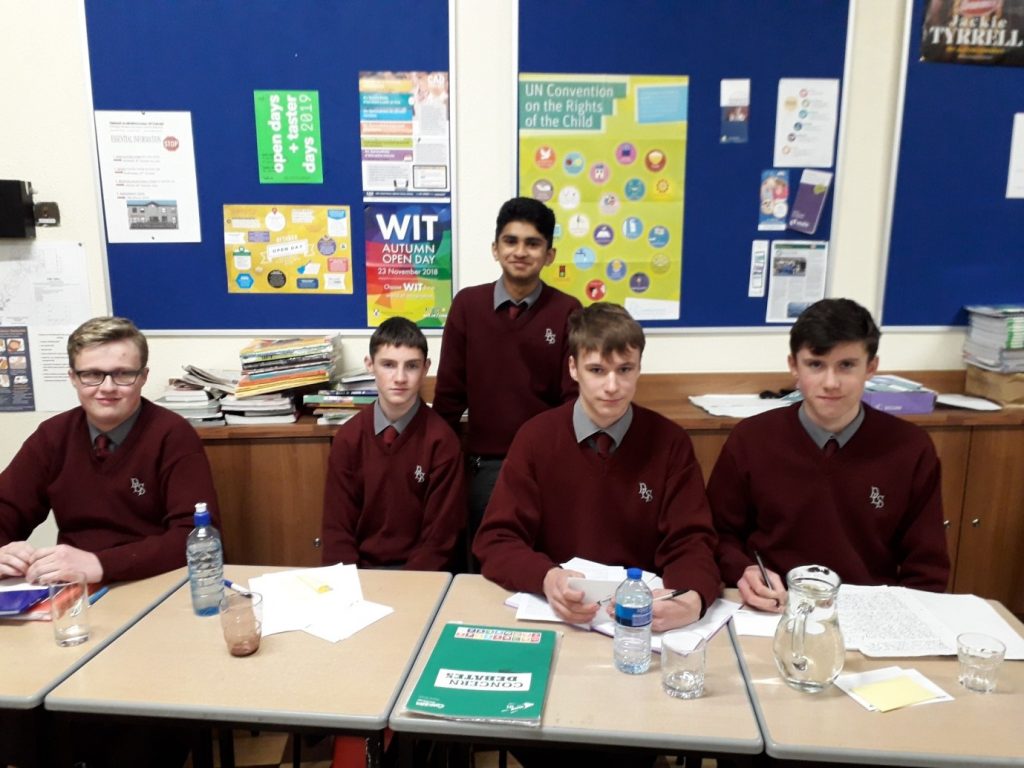
Our senior debaters travelled to C.B.S Kilkenny last night to oppose the motion, ‘Thirty years on the world is still no closer to ending the HIV and Aids epidemic.’ Unfortunately we were defeated to an experienced debating side. This was our first debate of the year and for all our debaters it actually was the first debate they ever competed in. It was a fantastic display from our debaters who put in a tremendous effort. Our next debate is away on the 16th of November against Presentation Secondary School.
- Published in News
First Year Choir 2018
This year’s First year Choir came together in mid-September and they rehearse for one class each week. There are 50 singers in this choir and they already make a really good sound. At the moment they preparing three songs for the Christmas Concert in December and these include; Yesterday, By the Waters of Babylon and This Little Light of Mine.
Christmas will be a busy time for them as they will be performing in The Christmas Concert at DLS and also the Carol Service. They will sing at Carols by Candlelight in the Sacred Heart Church on Monday December 17th and this year they will perform at Winterval on Wednesday December 19th. So they have lots to look forward to after Halloween and no doubt they will be great.

- Published in News
St Vincent De Paul
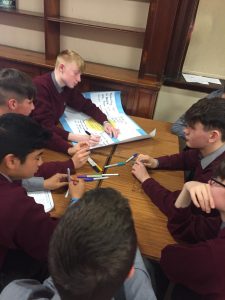
On Friday 26 th October a number of De La Salle Transition year students participated in a St Vincent De Paul Workshop.
The students engaged in group work and discussions on social justice, volunteering and awareness of SVP.
Ms Debbie O Halloran, SVP Education Officer and Ms Mc Manus Liaising Teacher assisted the students in setting up the SVP youth Conference of 2018

- Published in News
Ultimate Frisbee
Ultimate Frisbee takes flight in De La Salle College.
Destination: All Ireland Indoor Championship Finals in Kilkenny on the 13th March 2019.
On Friday 19th October 2018, 52 senior cycle students from De La Salle College Waterford represented our school for the first time in the South Regional Indoor Qualifiers in Ultimate Frisbee. The competition took place in the W.I.T. Arena and there were teams from Limerick, Cork and Waterford in attendance.
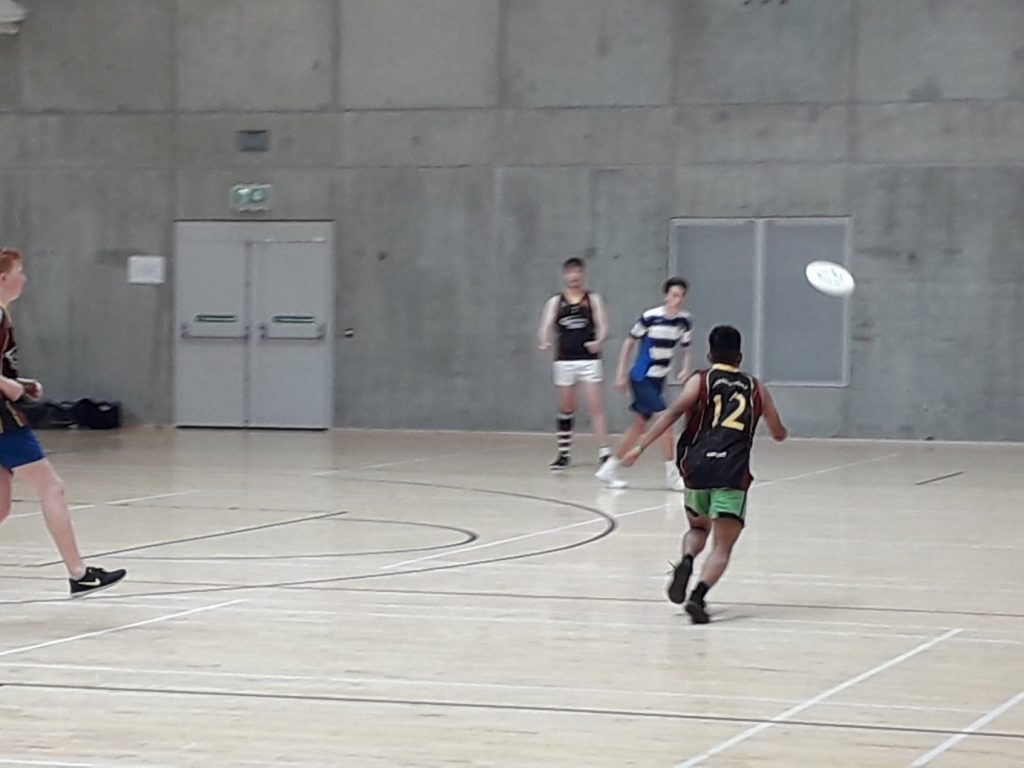 Our boys competed against the best in Munster claiming an astonishing 4 qualification spots from a possible 6 in total. They displayed their developing skills where one of the teams were victorious against the team who claimed top spot. They demonstrated their sportsmanship through the Spirit of the Game of Ultimate Frisbee. We are extremely proud of their achievements and we are now making plans for the finals in March.
- Published in News
De La Salle College Swimming
Congratulations to the De La Salle College swimming team who represented the school in the Munster Schools competition in University of Limerick on Sunday 21st October.
Those involved were 2nd year student Rohit Das, 3rd year student Noah Cowman and Transition year student Cian Barrett.
These students distinguished themselves in their individual events and achieved personal best times in their respective events. Noah reached the final of the Backstroke 100m event and broke a new personal best time. Well done to all three students.
- Published in News